
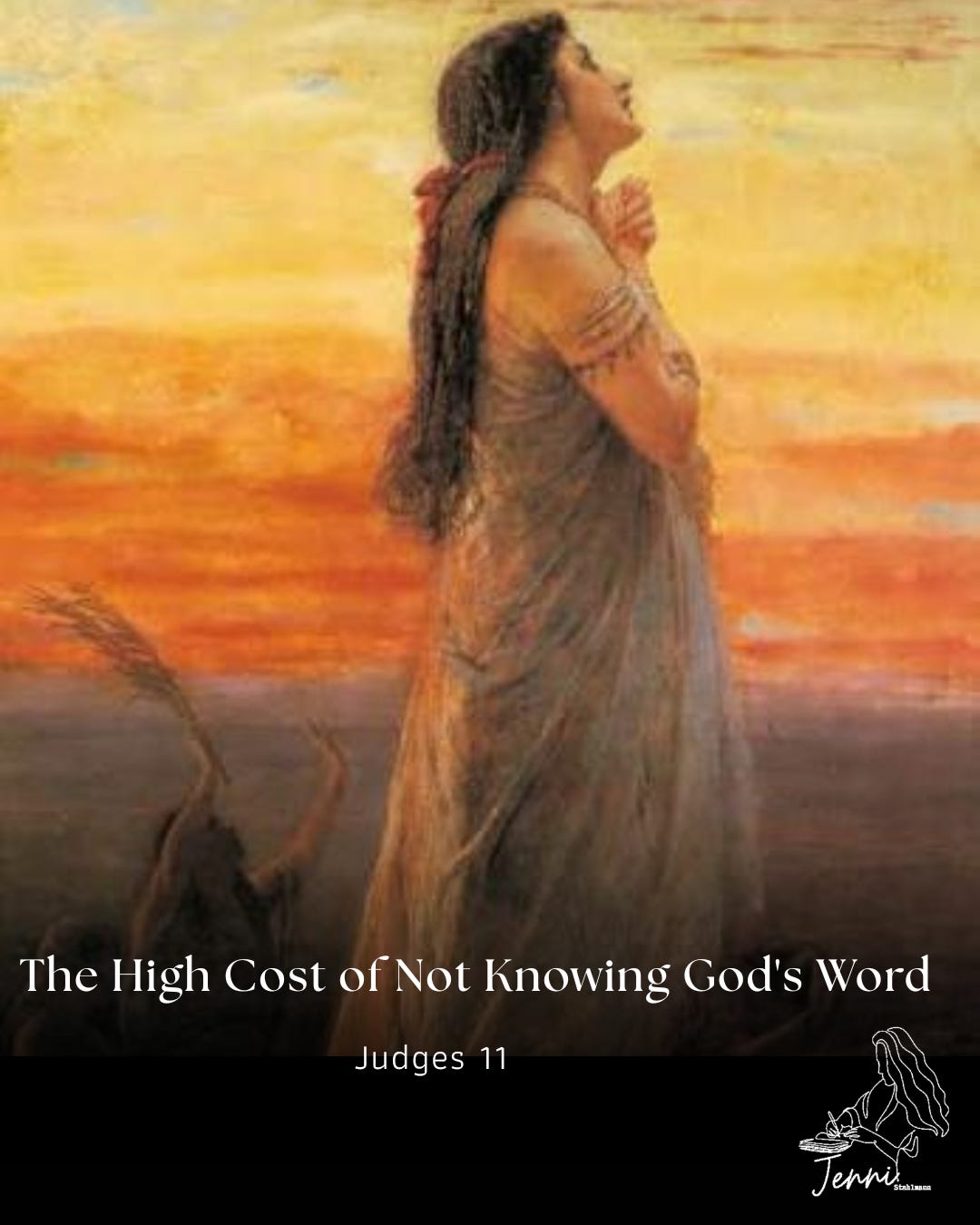
Imagine making a foolish vow that leads to unimaginable heartache, only to discover that God’s Word had already provided a way out. That’s the tragedy of Jephthah in Judges 11.
Before going into battle, Jephthah promised God that if He gave him victory, he would offer as a burnt offering whatever came out of his house to greet him. Imagine his horror when his only child, his beloved daughter, came dancing out the door when he returned home victorious.
But here’s the heartbreaking truth: God never asked Jephthah to make that vow; God provided a way out of rash oaths, and God prohibits human sacrifice in the first place!
We can fall victim to this bribery mentality too: “God, if you do this for me, I’ll [fill in the blank].” But God doesn’t need our vows to move Him to action on our behalf. Psalm 118:6 says, “The Lord is on my side; I will not fear.” Psalm 46:1 says, ““God is our refuge and strength, a very present help in trouble.” And Isaiah 41:10 says, ““I will strengthen you, yes, I will help you.” Those are just a handful of eleventy-zillion more!
In Jephthah’s case, he at least had the Law, and in the Law it says, “God goes with His people into battle, fighting for them and bringing deliverance” (Deuteronomy 10:4). And there are many more like it. So, right out of the gate, there was no need for him to make this vow. But okay, we can all be dramatic when we’re under stressful circumstances.
God made provision for these very moments. Had Jephthah known the Law, he would have realized that he could just offer atonement for a rash oath and moved on (Leviticus 5:4-6). No child sacrifice necessary.
And if he missed that one, Leviticus 27 provided provisions for redeeming people dedicated by vows. Plus, let’s not forget that God prohibits human sacrifice in the first place (Leviticus 18:21).
To be fair, there is some scholarly debate over exactly how these laws applied to Jephthah’s situation and whether his daughter was actually killed or just devoted to lifelong service (like a nun). I lean on the side of sacrifice because he said a burnt offering, and Judges 11:39 says, “He carried out his vow.” But either way, one thing is clear, had Jephthah’s known God’s word, it would have been a moot point.
And that brings us to the lesson.
Sincerity is no substitute for knowing Scripture. We can have all the good intentions in the world. We can have the strongest of convictions, and genuine faith, and still make terrible decisions because we don’t know what God has actually said.
How much heartache could we avoid if we spent more time studying God’s Word instead of relying on what we think it says?
Know the Word. It could save you a world of heartache.